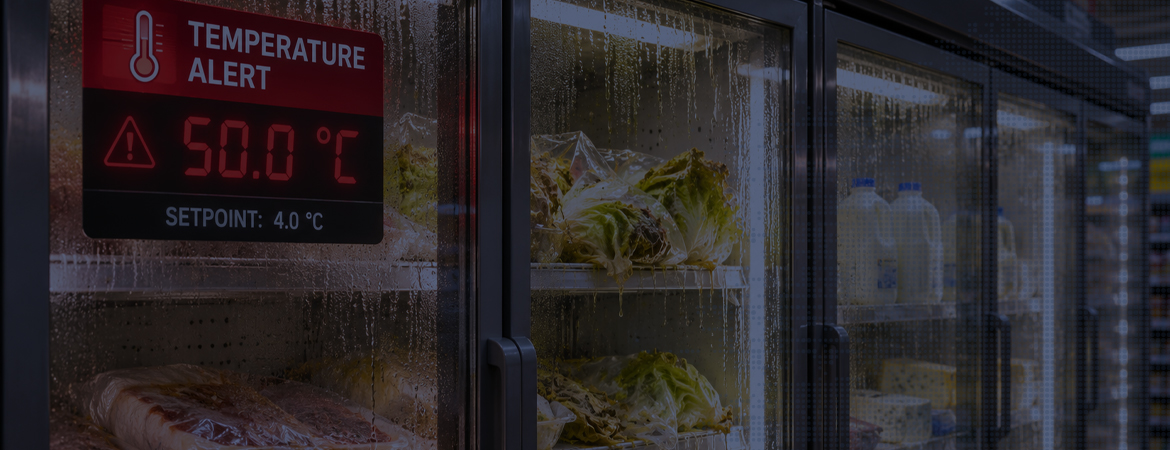
On the night of October 11, 2026, attackers reached refrigeration controllers in hundreds of French supermarkets and put fridges and freezers into defrost. Coopérative U said 80 of its 2,000 stores were affected and that the cold chain held in most of them. Intermarché said its affected stores had to throw away all the products concerned. Its parent company expected losses in the tens of millions of euros.
Same attack, same kind of controller, very different outcomes. Public reporting does not explain the difference. It does point to the question most OT security programs never ask: when a control fails, how much does it cost you?
Every new preventive control reduces the chance of an incident. After a decade of security programs, many of those reductions are large in relative terms and small in absolute terms. A second firewall, a new detection rule or another training module may cut the likelihood of a particular attack by half. If that attack was already unlikely, half of a small number is still a small number, and the consequence if it happens is unchanged.
Consequence reduction works on the other side of the equation. It assumes that some day a vendor account will be stolen, a controller will be changed or a front-end will go dark, and it makes that day cheaper. For most building owners and operators, once internet exposure, default passwords and remote access are dealt with, the next dollar buys more risk reduction here than in another layer of prevention.
Government agencies already put it on their short list. CISA, the FBI, the EPA and the Department of Energy listed the ability to operate OT systems manually among their five primary mitigations in May 2025, alongside routinely tested continuity plans, fail-safes, backups and standby systems. The December 2025 joint advisory on pro-Russia hacktivists, co-sealed by agencies in North America, Europe and Australia, reported that the most common operational impact of those attacks was a temporary loss of view that forced manual operation. Whether that is a nuisance or a crisis depends on whether your team can do it.
Pick the processes where a failure costs the most: cold storage, data room cooling, pressurization, life safety interfaces, water treatment, a production line. For each one, answer four questions.
1. What is the safe state, and does the equipment reach it without the controller? Know what the equipment does if the controller sends a wrong command or stops responding, and whether a hardwired limit or mechanical safety stops it first. Those do not care who logged into the BAS.
2. How would you know? If the only alarm comes from the same controller the attacker changed, you may find out from a customer or a spoiled delivery. An independent temperature logger or a hardwired high-limit alarm costs little next to the inventory it protects.
3. Can people run it by hand, and for how long? Name the people. Check that the procedure exists on paper, that local displays and hand-off-auto switches work, and that someone has practised it in the last year.
4. How long to restore a controller to a known-good state? CERT-FR told French operators with compromised controllers to reset them and reconfigure them before returning them to service, and warned that a reset alone leaves end-of-life devices open to compromise again. That takes hours if you hold a current configuration backup and a technician who knows the system. It takes much longer if the backup sits with a vendor, or if the controller is end of life. Danfoss said most units hit in France were older products that no longer receive updates.
Consequence reduction is not free. Independent alarms add hardware and maintenance. Manual operation drills take staff away from routine work and need careful planning on live systems. Configuration backups go stale unless someone owns them after every change. And none of it replaces the basics. A building with controllers on the internet and default passwords needs those fixed first.
What it does is cap the cost of the incident you did not prevent. That is also the measure to track: not how many controls you have added, but how many hours it takes to restore your most critical system to a known-good state. Test it once and write the number down. If it is longer than your operations can tolerate, that is your next project.
Prevention decides how often you have a bad day. Consequence reduction decides how bad the day is, and it is the part you fully control.
Planning so that when a control fails or is changed, the incident costs less: safe states, independent alarms, manual operation and a fast restore.
Once internet exposure, default passwords and remote access are dealt with. Until then, fix those first.
The hours it takes to restore your most critical system to a known-good state.
Planning a new smart building or plant, upgrading the systems in an existing one, or buying technology for a facility? Actimeta is an OT cybersecurity and technology advisory firm that helps owners get the design, the vendors and the security right from the start.
